Friday, December 26, 2014

Malaria Nerd Camp

For two whole weeks in the month of December, I was the luckiest spring chicken west of the Sahara because I was one of 30-ish Peace Corps Volunteers representing 13 African countries invited to attend Stomp Out Malaria Boot Camp in Thies, Senegal.

For two weeks we were put to the test with malaria life-cycle drills, behavior change exercises, skype dates with world renowned malaria experts, inter-Africa collaborative idea-exchange sessions and skills building activities. All of this was conducted under the strict but tempered eye of our sergeant, Stomp Out Malaria in Africa Coordinator, Matt McLaughlin.

And boy did it get me in shape. Not any sort of physical shape mind you, except that of some sort of amorphous blob after stuffing my face non-stop with the magnificent, protein packed, vegetable filled, divine, delectable, overly abundant food provided at the Thies Training Center (we had two pause-cafés a day with coffee, tea, hot chocolate, juice, bean sandwiches, and beignets spread out before us like a feast in the Hogwarts Great Hall in addition to three exceptional meals!).

But it got my head in shape. In fact, my mind, that may have been before like some partially-inflated balloon, perusing through, ruminating in and toiling over a variety of ideas without any really taking root and developing, is now on the brink of bursting.

I have so many ideas!!

I won’t bore you with the details as of now (I’ll leave that for a future post in which I can write rules for a drinking game and insert dirty jokes to help get your through it). But I assure you, they are there. And their timeliness was impeccable.

Before Malaria Nerd Camp, uh-hem, I mean, before Malaria Boot Camp, I was in a bit of a slump. Around six months in, many volunteers experience a bout of homesickness (our medical officers call this the “Rollercoaster”). This got jumbled in with my general fall nostalgia and the realization that most all the projects I had been devoting time to thus far were beginning to finish up without my having any specific idea about what I would do next.  I was in need of some inspiration.

And Malaria Boot Camp provided that.

We began by bringing in the USAID/President’s Malaria Initiative representative to give us the low down on all the big profile players in the malaria “in crowd”. She scrolled through slides of each organization, offering information on location and current activities, a bit like I imagine an FBI briefing to infiltrate a big organized crime ring. We were each equipped to be able to identify them on sight, know how to approach them and subtly suggest ways we could work together.

Later we skyped in a medical entomologist at the CDC. He got so excited about mosquitoes that he started bugging out and put his open hands up on either side of the his mouth to flap them together, demonstrating mosquito eating behavior.  We got to hear all about the world of mosquito control – what’s out there, how it works, what flies and what doesn’t.  Safe to say he got us buzzing.

A representative from the PATH, an international NGO head-quartered in Seattle, came online to introduce to us the next Big Kahuna in malaria control: the first ever malaria vaccine. While a variety of different vaccines are in the works, there is one undergoing final efficacy trials that is set to be approved and become available to children all over Africa in the next year (inshallah=god willing!).  While it won’t be 100% effective and isn’t meant for the entire population, it has tremendous potential. There has never been a successful disease eradication campaign conducted without an available vaccine (NOTE: the eradication of guinea worm is very close but this is a rare circumstance made possible the largeness of the parasite and the mode of transmission).

With USAID reps in Washington we talked about gender and malaria; ways to ensure that our programs do not systematically exclude any subsects of the population, particularly along gender lines.

With NGO reps, former Peace Corps volunteers and current Peace Corps volunteers we talked about ways to made malaria education not only digestible but delightful, such as using soccer analogies developed by Grassroots Soccer, a South Africa-based NGO.

We even talked about making radio shows, taking pictures and using different forms of media to get people interested in supporting the fight against malaria.

But in all of this, perhaps what was most inspiring, was the time spent with other volunteers. It is an inexplicably wonderful feeling to be a part of a group of all like-minded people, engaged equally in the intricacies of a subject that many people couldn’t care less about (is this what going to band camp is like?). From dawn until dusk (and sometimes to dawn again without sleeping), we shared stories of our generally comparable but sometimes quite distinct Peace Corps experiences, as well as our experiences in malaria-affected communities. We shared our thoughts about what does and doesn’t work in the world of malaria prevention and where we think the future of control efforts lies. And we shared our dream of working together during Peace Corps service and beyond to see to it that this this larcener of lives, this marauder of moxie, this despoiler of dreams, this ominous umbra darkening the days of millions of affected communities not only in Africa but around the world, is done away with once and for all – to see to it that in our lifetime malaria is eradicated.

While I was sad to bid adieu to all of my new friends and send them back to their respective African countries, I myself was genuinely excited to go back to village and get back to work.

(I only had a 3-day detour on the way back that rerouted me through Dakar for a TB test before I could get there. But don’t worry, it was negative!)


And now that I have made it back, I’m ready to get back to work.

My Fellow Boot Camp Nerds

#StompOutMalaria

Saturday, October 4, 2014

Bobo Siita!!

My brother's wife-to-be just had her first baby! It won't get its name until its 6 days old and they have the baptism.  So far I've been pushing hard for Trevor, Obama or Michael Jackson. Michael Jackson has been the most well received.  I'm afraid though it will probably just be named after the mother's father, Cheik.  We shall see...

My brother, Soba, and his first baby (boy)

Dande, my brother's wife-to-be, with Soba, my brother, and the new baby


Monday, September 15, 2014

PECADOM Plus

So, per allusion at the end of my last blog post, I’ve decided that it would be worthwhile to explain a little bit about the formal, actual “work” work I do here.  To date I have been reticent to do so because I know that while it is very interesting and exciting work to me, I am a pretty huge nerd and people less nerdy than I may not be predisposed to find it so fascinating. I am, after all, the one that once made Christmas sugar cookies in the shape of various parasites and diseases (HIV virus, Giardia lambila amoeba, Taenia solium tapeworm, etc.)…

Proof

And so, to make this post more digestible for those people who are not of my extreme-nerd persuasion, I have done two things.

One - throughout the blog I have sporadically placed joke answers and responses. They are not clearly identifiable simply from scrolling through the blog so you will HAVE to read through it to find them. I apologize in advance for the crude nature of many of these jokes. They are simply the ones that have stuck with me over time.

And two – I have devised rules to make the reading of this post into a drinking game. People who know me well shouldn’t be surprised by this given that I am inclined to make most anything into a game to make it more palatable or interesting.  The rules of the game are as such:
1.       Every time I say “Pecadom” take a sip of your beverage.
2.       Every time I say “Plus”, send me an email with an original compliment, something you have never said to anyone ever before (to smollenk @ gmail).

Are you ready?

What do you call a Roman soldier who is smiling with pubic hair in his teeth?

The region of Kedougou (the region in which I live), located in the southeast corner of Senegal and bordering both Guinea and Mali, has the highest rates of malaria in the country.  In my district specifically, the district of Saraya, malaria accounts for 25% of outpatient visits annually, up to 40% of outpatient visits during the malaria season (June to November), 85% of hospitalizations, two thirds of all hospital deaths, and 50% of deaths in children under the age of five.  It is the single greatest burden on the healthcare system. It also has an immense impact on the population physically, emotionally, financially and culturally.  A glad-i-ate-r.  Here, many people accept regular, debilitating, seasonal illness and the death of young children as a fact of life.  People do not know that in other parts of the world it is not normal for people to regularly fall ill with fever or that the death of young children can be only a rare exception to the rule and not the substance of it.

In efforts to control the disease and reduce its catastrophic burden, we as public health professionals emphasize two things: prevention and treatment. Why did the golfer wear two pairs of pants?

Prevention comes in several forms: the use of Insecticide-Treated Bednets (ITNs) to prevent the Anopheles night-biting mosquitoes (the vector for malaria) from biting while you are asleep; the spraying of insecticides on the inside walls of homes to eliminate resting spots for mosquitoes after they have taken a blood meal (aka Indoor Residual Spraying or IRS); mass drug administration programs to treat all children during peak transmission seasons (aka Seasonal Malaria Chemoprophylaxis or SMC); special preventative drug therapy programs for pregnant women who are particularly vulnerable to the disease for various reasons (aka Intermittent Preventative Therapy or IPTp); environmental clean-up campaigns to eliminate mosquito breeding grounds (standing water, etc.); the wearing of long sleeves and long pants or insecticides at dusk and dawn; and education about the disease and all of these techniques I have listed.

In regards to treatment we emphasize that all malaria cases should be treated and that they should be treated as soon as possible. In case they get a hole in one.  This is important to reduce the likelihood of the disease developing into the more severe, cerebral form, to reduce likelihood of death, and to minimize the opportunity for further transmission.

And here is where PECADOM Plus comes in.

Many barriers exist that prohibit rural populations from accessing care. These may be geographic (the doctor is far away, the road to get there is blocked by a seasonal river, etc.), educational (people do not know the importance of seeking medical attention early/at all when they have a fever or they think that seeking medical attention could be detrimental because if they have Yellow Fever and they are stuck by a needle they will explode – a belief unfortunately held by some here), financial (they cannot afford the consultation fee, the testing fee, the medication fee or to pay for transport to get to a health facility) or otherwise.

To address some of these barriers, the Ministry of Health in Senegal implemented a home-based care model called PECADOM. What’s the difference between like, love, and showing off?  For this program, volunteer community-based care providers known as DSDOMs (Dispensateur de Soin au Domicile) in rural villages were trained specifically to perform rapid diagnostic tests for malaria and administer malaria treatment for uncomplicated cases, referring all negative and severe cases to the local health post.  Instead of having to worry about how to get to see a doctor when their child was feverish, community members in these villages could go to the homes of these volunteers and obtain immediate, free malaria diagnosis and treatment.

While this program was very impactful, some limitations were still evident in the existing model. As case detection was passive (meaning that the DSDOMs just sat around at home passively and waited for sick people to come to them), malaria detection and treatment relied on the patient making the decision to seek care. Spit, swallow and blowing bubbles. This meant that the aforementioned educational barriers were still in play; people needed to make the decision to seek out treatment which remained an issue among community members who were not educated to do so.

In 2010, a Peace Corps volunteer named Ian Hennessee (or locally known as Fode Mari Tandian) piloted a project in his village, Missera Dantila, and two other very small villages in which they built on this program to turn it into an active model.  The DSDOMs that previously sat around at home and waited for their neighbors to show up whenever they were sick would instead be paid a small wage to conduct sweeps of every household in their village once a week during the rainy season to actively seek out cases. They would go house by house to ask if there were any people present who were sick with fever. What is similar about a Pope’s balls and the balls on a Christmas tree? Rapid diagnostic tests would be administered to anyone with symptoms and treatment would be provided on the spot, right in people’s homes. They called this new and improved version of the PECADOM Program, PECADOM Plus.

While initial results were promising, the sample size (3 villages) for this program was very small. Therefore, in 2012 and 2013, Peace Corps volunteer Anne Linn (aka Sadio Tigana, my ancien), partnered with the Saraya Health District to scale up this program to 14 villages in the Saraya District and conduct a thorough program evaluation to test its impact.  Her results (awaiting publication) were quite convincing.


At the start of the program a similar prevalence of symptomatic malaria, just over 1% of the total population, was found in both sets of villages. By the time rainy season was half way over, the prevalence was found to be 2.5 times higher in the comparison villages (in the normal PECADOM Program) than in the intervention villages (using active case detection in the PECADOM Plus program). When the program ended the prevalence in comparison villages was nearly 16 times higher than in the intervention villages, where only six cases of symptomatic malaria were found.

They are only for decoration.  This was enough to convince the National Malaria Control Program (Program National de Lutte Contre Le Paludisme aka PNLP) to adopt the PECADOM Plus program model and scale it up to the entire region of Kedougou this year.  And if it goes well this year, they will scale it up to the entire regions of Kolda, Tambacounda and Sedhiou (also high malaria prevalence areas) next year as well.

And this is now where I come in.

I forewarn you at this juncture that I have run out of jokes and so I have supplemented further text with numerous pictures. Hopefully that suffices to keep your interest.

While PECADOM Plus is officially a PNLP program this year, Peace Corps volunteers are still playing a big role. After all, it is a sort of Peace Corps baby that we all want to take care of and see succeed.  Plus, there is generally a shortage of skilled health personnel to supervise programs like this one and it is one of our official Peace Corps roles to help fill this gap. And so we have taken on many tasks.

We are trainers. I gave my first ever presentation in French to a group of 50-some-odd DSDOMs and Community Supervisors during Ramadan about how to form care groups with women in their villages (DSDOMs are asked to gather a group of women in their village, at least one from every household, and educate them about malaria).  I also spent several weeks racing all over the district - 70km in one direction, 80km in another - to work one-on-one with DSDOMs during practical trainings to practice treatment algorithms and learn how to use reporting tools.  Often I would lead role-play activities (in Malinke) in which I would pretend that the DSDOM had just entered my home and a member of my family was sick and in need of their care. Nicole, a fellow PCV, friend and accomplice in many of these trainings, would often play the part of sick and terrified child who threw a fit when the DSDOMs tried to measure her temperature (to their utter amusement) and pretended to cry when they fake-poked her finger to draw blood for the rapid diagnostic test. We would start with simple, straightforward malaria cases and then move on to trying to trick them by unveiling secrets along the way such as the fact that I was pretend-pregnant which meant they had to refer me to the nearest health post instead of treat me.


Upper Left: Me and Renee training DSDOMs about using reporting forms
Upper Right: DSDOMs receiving training on using reporting forms by Renee and I
Lower Left: Nicole training DSDOMs on malaria treatment algorithms under the mango tree
Lower Right: Travelling far and wide on bush roads to go help with training


We are supervisors. Every week (before all of these Ebola shenanigans in Senegal) we would accompany DSDOMs on their house-to-house sweeps to see them in action and make sure they were doing everything correctly in the field.

Picture on Left: Nicole and Ntafe Cissokho, one of our community supervisors
Picture on Right: A DSDOM and one of the women in his women's care group

We are watch-dogs.  Every week there are Peace Corps volunteers responsible for calling all the program Community Supervisors (the people who the DSDOMs report to) to inquire about whether or not sweeps happened that week, why they didn’t if they didn’t, what medications or tests they might be running out of and any other issues they may have.  We use this information to help identify issues early and find resolutions as well as to track important program indicators.

In this capacity we are also advocates.  When there are issues and concerns, we can communicate them to actors at all levels of the health system up to partners at the PNLP and PMI/CDC/USAID with whom we have constant communication.

Me and some congressional staffers from the office of Barbara Boxer to whom I presented about PECADOM Plus

We are data collectors. For the last 5 days I have had my head buried in reporting forms, entering data into Excel spreadsheets, cleaning data, analyzing data and working on reports for health posts, the Saraya Health District and the Regional Health administrators about the status of the program half way through its duration.

We are innovators. As the program has been scaled up to new level this year, there are plenty of new challenges that come along related to scale.  We have the opportunity to identify these processes that are not functioning efficiently and devise solutions for this year’s program and for adjusting the protocol for next year’s even more expansive program scale-up.

We are also educators. To the greatest extent possible, Peace Corps volunteers were present for the formation and training of women’s care groups in all the DSDOMs’ villages, meaning that we drove or biked out to all of these far-out villages to meet with the DSDOMs, meet the women in their villages and talk about malaria in their communities.

A women's care group gathering
So that is more or less PECADOM Plus. Or as we say in Malinke, “wo le mu le PECADOM Plus ti”…

And that is what the bulk of my work has been like here so far.

Tipsy yet??


I look forward to some compliments…

Thursday, August 28, 2014

All Work and No Play… Does it Truly Make You Dull??

This post that you are about to read diverges a little from my previous posts in that I’d like to move momentarily away from the subjects of language, culture and religion to illustrate what life is like as a Peace Corps volunteer.

Someone close to me asked me on the phone the other day, “You seem to be really loving it there - do you just feel like you are always on vacation?”

I had to subdue my initial guttural reaction which was to burst out with a high and mighty, “HA!”, the product of my feeling something between amusement and insulted at such an insinuation.

I do not feel like I am on vacation every day.

I feel like I am at work every day.

All day.

Every day.

Some of this, I know, is self-birthed, self-nurtured, self-inflicted pressure. I do not have an office, set hours or a direct supervisor who hands me a finite list of tasks to complete and as such, the line between work time-place and living time-space is blurred, left to be interpreted by Peace Corps volunteers like myself in our own unique situations.  For me personally, when I am without a person or structure that tells me when I should work and when I should play, when I am given the choice, I go to work.  I hold myself to high standards. There are so many things I want to accomplish and so I need to do lots and lots of to-do lists.

Side Note: Not all Peace Corps volunteers share this particular disposition. Many, in fact, do not know how to push themselves when they are not pushed and thus they go coasting along, never faster than allowed by the subtle slope of time. But contrary to an apocryphal understanding of what Peace Corps volunteers do stemming from stories of 1960s-70s Peace Corps volunteers who more or less got dropped off in the bush somewhere to hang out and sing Kumbaya for two years, Peace Corps has evolved significantly as an organization along with the role and work of the volunteers.  Today (and probably to some extent through the 1960s-1970s as well – I don’t mean to entirely discredit the service of these generations of pioneering volunteers) there are a lot of go-getters who are doing a lot of really difficult, important and fascinating work.

What is true for all Peace Corps volunteers though, regardless of their natural disposition towards a work-play balance, is the nature of the job itself.

Every day you wake up and go to bed on-duty. You must dress appropriately, greet appropriately, act appropriately and eat appropriately.  If you go to your place of work that day, you likely spend the day dreaming and scheming and planning and (inshahallah) doing whatever your community needs and wants you to do – like you would at home except with a cap for cultural awareness and flexibility for navigating unreliable logistics.  But as soon as you get off, you are not off-duty.  You may still have dreaming and scheming and planning and doing of your own to do for future projects or current projects with different work partners.  When you tire of that you have cultural integration to work on. You may get nights and weekends and really hot or rainy afternoons off formal work but informal work is never complete.  There are people you must go sit and visit with from time to time – important people like the village chief, neighborhood chiefs, religious leaders, various old men, and institutional administrators as well as family, extended family, extra-extended family, friends and neighbors.  There are festivities at which you must make an appearance - funerals, weddings, baptisms, holidays, etc.  And don’t forget language (or languages in my case).  Maybe you make a point of turning language study into work by sitting down with a book or making flash cards.  However, even when you don’t study so ceremoniously you will find that everything you try to do in village that involves other people constitutes a (sometimes exhausting) lesson in language comprehension and utilization; communicating with people and practicing language are one in the same.

Top all this off with 100-plus degree heat, 80-100% humidity, spotty cell phone reception, unreliable electricity, mosquitoes galore, spiders bigger than my fist, chronic GI issues, reoccurring skin infections, sweat on sweat on sweat, (often) tasteless and nutrient-lacking food, having to do laundry in a bucket and wiping your butt with your hand in lieu of toilet paper and the workload get seemingly a little heavier still.

It is only at our Peace Corps regional house, a 1-acre oasis of bare knees, Mexican food, luke-warm beer, a real-ish shower (cold water only and it is outdoors) and English language, that we find ourselves truly off-duty.

But it is very far away.  Travel between my hut and the Peace Corps house in my regional capital takes a minimum of 1-hour of travel time (if you are blessed to be free of mechanical issues) plus 1 to 3 hours spent waiting for a car to arrive and fill up with enough passengers to leave.  And many volunteers’ sites are even further from their respective regional houses than I am.

Plus, volunteers like myself cannot afford to go there often, both because of our meager monthly Peace Corps stipend and because we have so many other things to do in village.

And so, I work A LOT.

Fortunately, and perhaps necessarily for purposes of sustainability, I love my job.

Recently I co-authored an article for an internal Peace Corps publication to introduce the new stage (aka the newest cohort of volunteers to enter the country including myself) to the rest of the Peace Corps Senegal community.  In said article I described the Peace Corps experience as a:

…preposterously paramount, fantastically fool-hearted, wontedly formidable but (inshahallah) never indomitable, grueling, gratifying, marvelous fortuity...

And while my primary aim in writing such an alliteration-happy list of oxymoronical hyperboles was to capture the reader’s attention, I do truly believe the statement to be true.

Every day is an undertaking for the “fantastically foolhearted”, every day an adventure.

I love that the most reliable way to get to a meeting on time is to hitch-hike with Malian truck drivers who (for my benefit?) play Phil Collins’ In The Air Tonight and go bananas when I break out the air-drums for the big steel drum solo.

I love that because my work is not defined for me I get the opportunity to define my own work. I get to choose the projects that interest me – malaria, HIV, typhoid...

I love that in the process of hammering out details of a visit by cervical cancer researchers to my district hospital I get to hear (in French) about the midwife’s life-altering trip to the US, her all-consuming adoration of Little Rock, Arkansas (huh?), and how she serendipitously found herself sitting in Bill Clinton’s chair on her birthday.

I love that working in a resource-poor environment demands a certain resourcefulness, a certain scrappiness, and a certain creativity in devising solutions to problems.  We can’t just buy our way out of things; we have to find back-doors and forge new paths.

I love that on my walk to work I run into 10-foot-long poisonous snakes with fangs like daggers (is love maybe not the right word here?).

I love that there is an utter lack of limpidity.  While at times the labyrinth-like obscurity in effecting every-day tasks may be harrowing, boredom is never a worry.

So when I get in bed each night, succumbing to the languor settling in after a long day hard at work, I know I am in the right place. I know that this is truly a “marvelous fortuity” and that later in life I will realize how “preposterously paramount” this experience has been, even if I end up spending two whole years in a row at work.


And maybe someday I’ll write a blog post where I actually tell you about what I actually do for work (lol)…

Tuesday, August 12, 2014

Pictures: My First 3 Months in Saraya

My last month in village has been filled with so many crazy and wonderful adventures that I would like to share with all of you but, unfortunately, all the crazy wonderfullness has kept me from finding a time to write about it. Here are some pictures to tide you over until I get time to post a real blog...


Saraya, my home


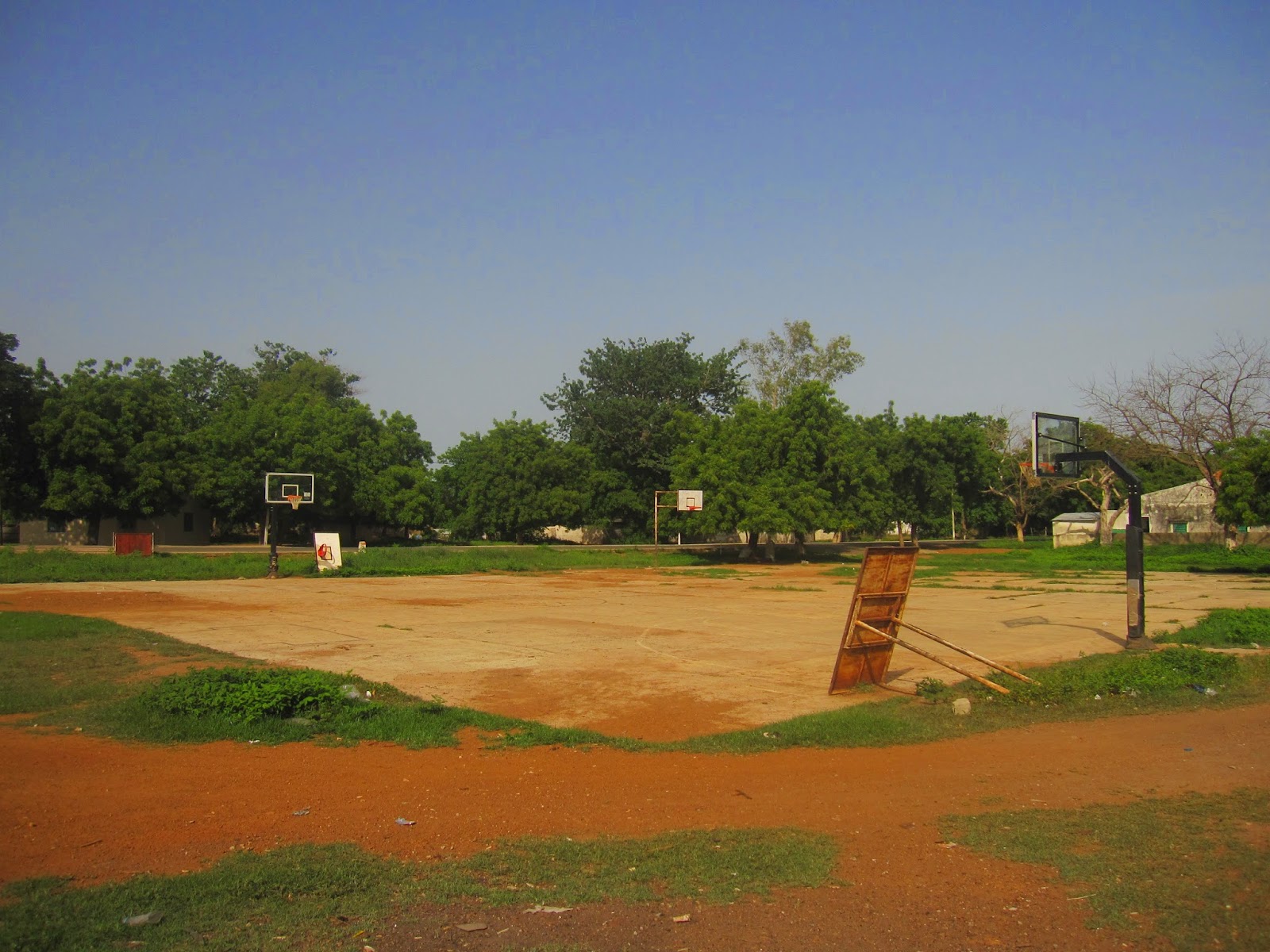
The Saraya basketball courts (courtesy of NBA Cares)


Downtown Saraya: the market, mosque & boutiques


Saraya mosque


The tailor shop outside my house with some of the boys who work there


My hut


My sister's daughter and my namesake's daughters; the spunkiest girls in all of Senegal.
(From left: Samuro, Kunadi, Allamuta)


My namesake's youngest son, Sambely


Me and Allamuta #1
(Study the faces carefully)


Me and Allamuta #2
(Study the faces carefully.
For anyone that has known me since childhood they should see be able too see the silly-picture/serious-picture pattern and see why Allamuta and I were so quick to become friends)


My sister, Dioucounda, braiding my hair for Korite (end of Ramadan celebration)


The outcome of the hair-braiding.
(All I wanted was to not look like Coolio...)


My host mom, Sadio (in the green/yellow dress with the red necklace and white head scarf), and some friends from around town on Korite


Diabou Tounkara and Diabou Tounkara
(I'm the one on the left, just in case you were confused)


My sister, Dioucounda, and her youngest daughter, Oumou


My host dad, Ibrahim, sitting in his favorite spot in the shade structure


Caroline (my site mate), Tess and I on our way to language seminar in Misserah Dantila (~60km from Saraya)


Me, Mr. Sall (Saraya English teacher) and my site mate, Caroline, at a party with all the local teachers

Tuesday, June 17, 2014

5 Week Challenge – Status: COMPLETION

Well fine ladies and gents, friends and foes, comrades and countrymen, and anyone else who maybe stumbled accidentally upon this blog via Google search but was so captivated by my witty title or flattering author picture that they decided to start reading… I have officially COMPLETED the 5 week challenge!!

I am now fluent in both Malinke and French. As well as Wolof. I can carry water on my head for miles. I can eat rice neatly out of my hand without spilling. I know everyone’s names in my village. As well as all of their children’s names, where their parents came from, what they farm in their field, what their favorite foods are, what all of their hopes and aspirations are for their lives and their children and their grandchildren, and what they think about every night in that peaceful moment of diaphanous clarity just before falling asleep.

Except that I don’t. I don’t know any of that. Such a claim would be both pathologically facile and a blatant lie.

And yet, I am still glad to have participated in the challenge. Here is why:

For one, my language skills have indeed improved significantly.  I am, by no means, anywhere near fluent.  But I can at least have a conversation. I can order food. I can ask for directions. I can ask about people’s children or about their work. And I can tell people that malaria is bad so they should hang their mosquito net.  And I trust the rest will come in due time.

Secondly, I have started to get to know people. I know all the names of all 25-35ish people (the number fluctuates) who are living in my compound as well as most doctors, nurses, lab technicians, midwives, birth attendants, pharmacists, community health workers, housekeepers, guards and chauffeurs that work at the hospital in Saraya.  I know most of the boutique owners and most of the ladies who sell hot bean, egg or tuna sandwiches in the morning. I know many of the kids that play basketball in the evenings and quite a few teachers at the middle school/high school. People have started getting used to my presence here. They know my name and they know that I live here; I’m not just passing through.  All of that is critical for me to begin to feel like Saraya is my home.


Thirdly and lastly, I’ve started finding my niche.  Probably most new Peace Corps volunteers or trainees, or people about to leave for Peace Corps staging, would corroborate the notion that the scariest part about going into the Peace Corps is indefinite expanse of unknowns.  For SO LONG, you just don’t have any idea about what your life will be like in any respect for the looming 27 months (2 years + 3 months). Little by little this gets less opaque. Around a year after applying you generally find out what country you will be going to and when. Six to nine months later when you actually arrive in country you find out where exactly in that country you will be going for training and what language you will be learning. A month or two into training your actual village placement is revealed and you have the chance to see it for the first time – see the people and the houses and the environment of where you will be spending the bulk the next two years.  But then a month later, fully “trained” and ready to go with all your clothes, food, water filters, medical equipment, etc., you arrive in village and you still have no idea what they hell you are doing.  This is NOT one of those jobs you show up to where you show up to be handed a list of tasks, duties you are responsible for and deadlines.  There are no deadset work hours or work days (or weekends for that matter).  You may or may not even have a physical location where you go to do your work. And you may or may not have any idea who you should be working with.  Peace Corps technically assigns each volunteer a “counterpart” who is a community member that has agreed to be the volunteer’s work partner and help them facilitate projects.  This person generally attends a 3-day training workshop in Thiès with the volunteer (although my work partner was absent for this) to orient them to the goals and methodology of the Peace Corps and how they can support their volunteer.  However, their involvement in the volunteer’s work and inclusiveness of the volunteer in their work varies on a wide spectrum from counterpart to counterpart.  This is therefore a job where you have to FIND your own work. You have to go out, talk to people, follow people around, ask questions, take notes and YOU have to CREATE your own role.  You need to find the things that need to be done and do them.  During these 5 weeks, I believe I have begun to find some of these things.  Just by hanging around the health center every day for example, I was invited to attend an HIV screening in a small village about 2.5 hours outside Saraya called Bambanding. During the screening it became apparent that there had been no community mobilization for the screening because there was not a Relais (a community member trained in a specific health topic) in that village who had been trained in HIV. Therefore, nobody was telling village members about why HIV is bad, how to prevent it or why to get screened. So only 17 people showed up to be screened that entire day…  Enter Diabou Tounkara (me)! HIV education and Relais training may be just the perfect place for me to start my work here...

While I may, at times, feel like I have hit the ground running already, I know that the real work is truly just beginning.  There is still so much to learn, so many people to meet, and so many health issues to tackle.  But I probably need to go to the capital for a salad and a beer to celebrate making it this far before I jump on into it.

Yay for the end of the 5 week challenge!!

Friday, June 6, 2014

Spot is sitting. See Spot sit. Sit Spot sit!

Hello Sagna, is there no evil with you?
Hello Diabou, there is no evil with me.
You are sitting.
Yes, I am sitting.

This is the conversation I have every morning with the skinny guard in loud-patterned pants, a t-shirt, a wool-knit beanie and flip flops, who sits on a plastic chair outside the old health center building that I pass on my way to work.  Stating the obvious, here in Senegal, transcends cultural appropriateness to be truly, culturally encouraged.

You are sitting.
You are eating.
You are drinking tea.

All of these are both blatantly obvious facts and regular conversation topics in village.  Such a culture of stating the obvious, I have discovered, has some real advantages.

For one, all day long these conversations function as endless vocabulary lessons for learning verbs.  I don’t have to actually ask how to describe what I am doing ever.  I just have to do it and wait for someone to walk by and tell me.

Diabou, you are shelling peanuts. (I be tiga woto la)
Why, yes! I am shelling peanuts! (Iyo!, Mbe tiga woto la).

Bam. Learned the verb “to shell” (xa woto).

Furthermore, stating the obvious is a great door opener for entering more stimulating or prudent conversation.

Diabou, you are shelling peanuts.
Why, yes! I am shelling peanuts. Peanuts are delicious and a good source of protein!

Bam. Nutrition conversation. Had. (#LifeOfAHealthVolunteer)

Plus, describing the most evident and benign details of someone’s present existence is a great way to make new friends.  People simply find it to be extraordinarily normal and instantly, heartily, relate to you when you make such statements.  As soon as I tell people they are sitting, they laugh and a whole layer of cultural-distrust melts away because they can tell that I am not just any tubab (white person); I am here for real and want to understand the culture and form relationships.

Of course, there is another side to this in which you may prefer people to not state what is evident.  Sometimes, as Americans, there are things we all know – things we all know we know – but we all tacitly agree to not speak aloud in order to save someone from embarrassment or shame.  For example, here one might hear (or say):

Diabou, you are gaining weight.

Or:

Diabou, you don’t hear (understand) Malinke well.

In these particular situations, it may take all of your wits and sensibility to keep in mind that these observations are not stated with malicious intention.  They simply are.

Yes, you must say. I am gaining weight. Peanut sauce is too delicious!

Or, yes, I don’t hear Malinke yet. I am learning.

To get angry and retaliate would be fruitless because people here do not see that they may have offended you and do not understand why you could be mad.  If you are, after all, gaining weight, why beat around the bush?  Here it is among the highest of compliments to you – as you intentionally or not are growing into the African vision of beauty with voluptuous curves and thick limbs – to your family – who can afford to keep you well fed – and to the chef of your house – who must be a wonderful cook to be able to keep you eating.

The repeated reminders that I do not yet speak Malinke may be, at times, quite discouraging, but then I will say something unexpectedly correct or complicated or humorous and just as quick as they were to tell me I don’t understand yet, they will tell me I am done learning.  In these times I have to make sure to promptly and deliberately walk back their inflated expectations.

At the end of the day, stating the obvious might seem like a funny thing to do, but it isn't like we don't ever say stupid things in America.  In fact, when you can very clearly see what someone is doing, why do we Americans, still ask?

Hey, what's going on?

Can you not already see what is going on?

Maybe, the Senegalese are on to something.  Maybe they are really just speeding the conversation along.  Once you acknowledge the obvious you can move on to the less obvious...?

Regardless, it is yet another funny, albeit a bit awkward, cultural thing that I am growing accustomed to here in village life.  I've compiled a list of some other things as well for your musing:
- Biking with a live chicken swinging by its feet from my handlebars (I get goose bumbs whenever the wing gets caught in my spokes)
- Walking into stranger's homes to buy peanut butter (such is the nature of a predominately informal economy; to buy a product made by hand you must find that hand that makes it)
- Calling people "my slave" (this is a favorite joke among joking cousins in Senegal but as an American, for evident historic contextual reasons, is quite awkward to get used to)
- Using a loofa (its just never been my thing)