Friday, March 13, 2015

A Qualitative Comparison of the Effect of Recent Experience in Time and Space on How We See What We Look At

S Mollenkopf1 and S Mollenkopf2

Author Affiliations:
1 Preventative Health Educator, Peace Corps Senegal
2 Mother of Preventative Health Educator, Peace Corps Senegal


ABSTRACT
I haven’t written a blog in a while because I didn’t really feel like I had anything worth writing about. I did finally write a blog in light of my mother’s visit to Senegal. I compared our views of certain things and places in Senegal in respect to our very different, recent experiences in time and space. Some things we characterized in similar fashions while other things demonstrated stark differences. This provides evidence for individual experience defining the differences in what we look at versus what we see. Its long though, so beware.

BACKGROUND
I have been having a bit of writer’s block recently in respect to this blog. Every time I sit down to put some words on paper, it just seemed to come out as some form of tedious, trivial, grandiose rambling about some minute cultural detail or change in my mentality that I wanted to sound cool but I was truthfully not overly enamored with so in the end it all just sounded really dumb; it sounded inauthentic. And if there is anything I promised to myself that this blog would not be, it is inauthentic. I don’t want to write something just to write it, just to make you read it. I don’t want to just recount my day for you – what time I got up, when I went to work, every time I pooped and what I ate for lunch and dinner… I want to write something because I have something to write, because I have something to say, because I care about something. So in an attempt to spare you the time and effort spent reading cr*p for cr*p’s sake, I have forgone several weeks of blogging.
That being said, I did stumble on something worth writing about. For the first time in my service (I have now been in country for a whole year), I had the occasion of hosting my very first guest: my mother.

Over her two week stay we did a range of activities – everything from visiting my village and getting to experience a little of village life to walking with lions, bird watching and tackling the chaotic, open-air markets. What stood out about this trip however (beyond the exotic animals, beautiful vistas and amusement of watching my mother, hair braided, dressed in African garb, trying to no avail to pronounce the names of my family members) was how it brought to light the difference in our perspectives as a result of where we are coming from in the time and space of our recent experiences.
I remember meeting two of my best friends in Morocco after a year of studying abroad in college. They were coming from Madrid and Paris respectively where they had each spent a semester studying, and arrived by quick-jaunt flights on discount airlines.  In contrast, I had spent nearly 6 weeks travelling by land through Burkina Faso, Mali and Senegal in broken buses and janky taxi-vans from where I had been studying in Ghana. When they arrived, each giddy with excitement, they exclaimed “I am in Africa!” I, on the other hand, equally giddy with excitement, exclaimed, “I am in Europe!” It seemed to be that our point of departure dictated our perceptions of our point of arrival.
Knowing that I was approaching this vacation with my mother after a year living in a Senegalese village, a year getting to know the language and culture and way of life of people here in Saraya, a year getting used to the heat and the sweat and the bugs and the smells, while my mother was just stepping foot on the African continent for the first time since she was 5 years old, I suspected we were going to stand side by side together, looking at the same things, but seeing them very differently.


METHODS
Being scientific-minded (and an extraordinary nerd), I decided to put this to a test. Due to the fact that there are infinite confounders that cannot be adjusted for derived from a lifetime of differences in experience between my mom and myself, I decided a qualitative comparison in the form of a series of anecdotal reports like a quasi-case series would have to be good enough.  I wrote down 5 topics and asked my mom to write a little paragraph describing her perceptions and experience with each one. She was instructed not to sugar coat anything, not to write about how she thought it should be written about, but only to write about what she actually saw.  Simultaneously, I completed the same activity about the same 5 topics without reviewing her answers. I then compared the responses for each prompt, bolding what I identified as differences and underlining what I identified as similarities.


RESULTS
Here are the results.

“Saraya”

SARAH:
Saraya is a fairly large village as far as villages go and just seems to be growing larger every day. In a matter of months there are all sort of new stores selling new things that weren’t previously available and a whole new, organized, shaded market place to buy vegetables. Some areas of town have the feeling of being under construction constantly but that isn’t to say that progress isn’t being made. It’s a very diverse down relative to its size with a mix of Malinkes and Pulaars and more Wolofs, Malians, Burkinabes, and Nigerians coming every day to work in the gold mines. And although I wouldn’t say it is urban exactly, I would say that there is a lot going on as it is the departmental capital and home several levels of government, the district hospital and several NGOs and there is definite, evident structure to the activity. Additionally, Saraya may be somewhat small but it is definitely not quaint; it really has everything you need – food, toiletries, hardware items, clothes, electricity (part of the time), water (although it can be difficult), and a 3G network!

MOM:
Saraya, the village . . . a long journey from Dakar. …
The pre-viewed photos prepared me only for how it looks . . . there is so much more for the senses.  It was HOT.  The call to prayer floating on the breeze.  The sheep and the goats.  The donkey that rolls over to scratch his back in the middle of the main street.  The stars.  The endless greetings – handshakes mostly and a few words in Malinke to be polite.
The Cissokho family was gracious and generous, welcoming me with a special dinner of salad and bread.  I was given a Malinke name . . . Dialunkaba Macalou. . . named after Sarah’s namesake’s mother   . . . that, coupled with a new hairdo and an African wax print dress made by the local tailor helped this Toubab melt cultural and language barriers enough to share a few laughs.
The village women spend a great deal of every day being homemakers . . . and they are buff!  They pound the grain or fish with a well-worn log in a deep narrow wooden bowl (not a stick . . . an actual log), they cook over an open flame or fire pit, they clean, tend the children, wash clothes and dishes, etc.  Kind of like camping – all the time.   Never did really figure out what the men do!
The women splash the otherwise bleak landscape with color.  When they go out, they are dressed in rainbow of African wax fabric gowns.  They sometimes carry big bright tubs full of stuff (laundry? water? rice?) on their heads.  They can toss their babies on their backs with one hand and tie them on with a wrap skirt or piece of fabric (no baby backpack).
There seems to be a constant bustle in the streets . . . strolling the village with Diabou Tounkara, I met a doctor and some nurses, a restaurateur with triplets, the tailor, the coiffeur, the village chief. Many people know Diabou and come out of the woodwork to greet her. There is a school, basketball courts, soccer field and hospital.  There is one paved main street with lots of big trucks rolling thru to/from Mali . . . everything else is dirt.  Despite a lack of any form of 20th century conveniences, the kids play with whatever they find (like a protractor!), they chew gum, giggle and squeal and cry same as kids everywhere.  The babies are cuddled and adored (Michael Jackson was learning to sit up!), everyone seems to have what he or she needs.  Simple, hard but also nice.  No place for sissies.

“Dakar”

SARAH:
Dakar is a big, beautiful, bustling city with beautiful ocean views and (almost) every amenity you could ask for (at a price). The thing I really love about Dakar, besides the beautiful vistas along the ocean bluffs and the perfect weather reminiscent, in my mind, of living in LA, that together offer an ounce of serenity in an otherwise fast-paced city is the way it has all the best to offer of both the developing and developed worlds. You can walk down the street and get a 200 CFA bean sandwich for breakfast (about 40 cents) or you can go to a divine French bakery and splurge $10 on a latte with the foam poured fancily like a leaf in your cup and a mouth-wateringly good chocolate croissant.  Sometimes the traffic is a little hectic, but it has nothing on the traffic jams of San Francisco, or LA, or any other city I’ve lived in. Plus it is clean and there are no homeless people (two more points over LA and SF). And the transportation garage is extraordinarily clean and organized.

MOM:
Dakar, the big city. Not like NYC big . . . big in a way I was not prepared for . . . a foreign country kind of big.  Getting through the airport was a piece of cake.  Getting out was a different story . . . surrounded by men jabbering in Wolof (?), grabbing my bag and being all too helpful . . . for a price.  Taxi out of there, quick. I could see a sprawl of half-built buildings standing everywhere – more half-built than complete.  Traffic and taxis, the smell of diesel fuel and lots of people.  I am inescapably white – I stick out like a sore thumb.  The Ex-pats have it good here.  A nice American school.  A beautiful sports field overlooking the Atlantic Ocean.  Coming back at the end of the trip.

“African Beauty Salons”

SARAH:
I have now had my hair braided twice in village. The first time it was braided by my sister for Korite (2nd biggest Muslim holiday) at the last minute. The awkward extent to which I resembled 1990’s Coolio after that incident prompted me to seek out a hair professional when I decided to braid my hair again for Tabaski (biggest Muslim holiday).
While the hair dressers themselves are incredibly fashionable and sassy and a lot of fun to hang out with, the experience of sitting in their salon is always a little hilarious. In one corner of the small room there is a fake Christmas tree about 3 feet high, donned in shiny, gold garland that then stretches off the tree and along the mantel, extending the entire length of the wall to accommodate all the various beauty supplies. I know people here think garland like that is fancy but the gawdiness is never lost on me.  Additionally, on three of four walls there is the same poster featuring a matrix of women showing off different hair styles for inspiration with the title “Hair Saloon” (not “salon). And one of these is a black girl with a straight pony tail called “Dolly” (who is named Dolly these days??). And of course the clientele who come in with chemically bleached skin (their equivalent to tanning) and request make-up like a drag queen (although not as subtle) provide some good people-watching to make the hours of tugging on your scalp go by a little faster.

MOM:
The trip to the coiffure to have my hair braided was not something in the initial plan but I decided on a whim to do it and it went over well.  This is the female equivalent of shaving one’s head – a no wash, no dry, no bed-head do that can be put up in a ponytail, stuffed under a hat or stylishly wrapped in a scarf.  It is so much cooler, surprisingly . . . even with a packet of mesh woven in.  Perfect Africa do. The salon was sauna-hot . . . until the power came on at about 5 and fired up the one fan.  One woman braiding, the other handing the strands of mesh.  Most of three hours to complete.  A village woman rolled in to have her make up re-done to match her outfit change . . . it was baptism day for her baby.  Take off the big smears of gold glitter eye shadow and the crazy beautiful white gown, reattach the gold beaded garland in the up-done hair . . .  a little powder touch up . . . reapply turquoise and magenta eye shadow to match the next dress, re-apply the hot pink lipstick  . . . rearrange your boob and stuff your one-week postpartum self into your schmancy gown, dawn your blue rhinestone covered stilettos and head down the dirt road back to the party.

“Pooping in a Hole”

SARAH:
I must say, while many people probably would not trust the authenticity with which I say this, I truly like to poop in a hole. Of course, it does depend on the hole. The hole in my own back yard is the best because it is wide open so it doesn’t smell and there aren’t a lot of flies. Some darker, less well-ventilated public poop holes are a little less pleasant to use but I would say the same for darker, less well-ventilated public toilets.
At the end of the day, it is nice because you just squat and do your thing. You aren’t wasting a ton of highly-valuable, sparsely available, potable water to flush it down. You never have to worry about a clog. You don’t have to worry about people that can’t aim and peed all over the seat. You don’t even have to worry about remembering to buy toilet paper once you get used to using your hand to wash your backside. And once you get used to the position, you get to build some squatting muscles in your legs as well.
All in all, I’m a fan.

MOM:
There is a hole in the ground which one inevitably needs to use.  Most important thing about it is to learn where to plant your feet.  And . . . don’t get too close.  There seems to be more things coming out of it than going in.

“Eating at the Communal Food Bowl”

SARAH:
Eating at the food bowl is like a group of hungry lions fighting over the gazelle carcass. As soon as the lid is lifted, the smell begins to waft and mouths begin to water. It is not, however, until a portion of the rice is removed for later snacking and the sauce is poured in generous portions over the top that the patriarch or matriarch of the bowl will signal that eating time has begun. From there it is a tricky game balancing hunger and desire for the tastiest, most nutritious things all gathered at the center of the bowl with cultural standards that demand you share with one another and don’t take more than your allotted portion. Additionally, once you go for some of the good stuff, anybody is allowed to go for it so you don’t want to open the flood gates if you aren’t prepared to swim swiftly. You want to go for the good stuff, but you want to do so without inviting the ill-will or competition of those around you.
Women have a particularly challenging time getting the goods if they are not at a female-only bowl. They often wait patiently until their husbands and brothers have eaten their fill of the vegetables and meat before they take their share, even if that means that all the vegetables and meat will be exhausted before they have a chance to take some. I prefer to think of this action as a willingly generous gift on the part of the women that care so lovingly for the men in their family and not as the women lying flat under the heavy boot of the men that walk over them but sometimes it is hard to tell the difference.
That being said, there is a communal aspect of the bowl that is very, wonderfully inclusive. Anybody, anywhere will invite you to a meal if you pass by while they are eating.  It is only polite to do so. Of course, they don’t really expect you to join as it is not so polite to actually accept the offer although they would not refuse you if you were hungry and wanted to eat.

MOM:
The communal food bowl is a concept worth advancing to the developed world.   One uses his or her spoon – or maybe just the right hand – leans in and heartily gobbles up the portion of food in front of them, walking away when they are done.  The Cissokho family does this daily at all three meals . . . I just shared lunch and dinner.  Lunch is in the heat of the day, about 2 PM . .  . dinner is by flashlight, somewhere about 8.  Bowl is served on the ground.   One dish to wash, a pot or two and a couple of spoons . . . easy peasy.  Usually rice with something on it . . . leaf sauce – big yum . . . peanut sauce – OK, not too bad . . . fish and fish balls – must be an acquired taste. . . salad with bread was delicious.


DISCUSSION
These results reveal a few themes. Firstly, as expected, we seem to have different perceptions or standards of what is considered “nice” and what is considered “tolerable”. The poop hole is a case in point. While I described it as, “nice because you just squat and do your thing”, my mom described it as, “a hole in the ground which one inevitably needs to use”.  She noted that, “there seems to be more things coming out of it than going in” while I specifically described it as not “smell[ing] and there aren’t a lot of flies”. Likewise, my mother’s description of Saraya focused on the goats, sheep and donkeys, characterizing the village as, “simple, hard but also nice.  No place for sissies” while I described it as “organized” and “definitely not quaint”, pointing to all the services and amenities available there that are not so available in other villages. It therefore seems our recent experiences may have affected our standards of quality; perhaps prolonged stays in relatively more bantam circumstances intenerate the hardship associated with them.

Secondly, there is an evident difference in what we are looking at when we look at something. The commentary on the food bowl is a perfect example wherein I ranted about the social dynamics of who can take what and when and how cutthroat-competitive it sometimes feels when trying to get your hands on the good stuff. My mom, conversely, saw the food bowl for what it was: a bowl of food, shared among family and friends at each meal, with different qualities of foods served in it. Similarly, in our descriptions of Dakar, my testimony largely reflected Dakar as a whole, the city happenings and the landscape.  My mom’s focused on the limited time period in which she initially saw the city, immediately after landing from a long 2 days travelling, jet-lagged, hectically navigating the airport, unable to speak the foreign language, picked up and immediately dragged to an ex-pat softball tournament to watch some games. Having both eaten out of many food bowls and having visited Dakar multiple times previously, I seem blinded to what is right in front of me; I no longer see the objects and the people simply for what they are. My mom was able to see them and take note of them.

And lastly, it appears that some things, like an African beauty salon, just seem ridiculous to us as Americans regardless.  The gold garland, the oppressively heavy make-up in vibrant colors, the awkward posters and the women that we can’t help but stare at as they re-adjust their boobs to get their top to fit and don fancy outfits complete with crystal-covered high heels in anticipation of whatever big event they are about to attend grab our attention for their gaudiness or garishness or flamboyance or whatever. But we both look at them and not beyond them because experience here does nothing to make those things and that behavior more comprehensible.  And we both find in them some sort of quirky, peculiar whimsicality and some type of resulting humor.


CONCLUSION
More people should come visit. I will probably make you contribute to my blog. But I’m interested to see how you see my world!


APPENDICES
Appendix I: A Handful of Pictures from Our Adventure

The arrival

Lunchtime

Drinks on the water


A few birds

Post-Braid
Not a part of this trip but I had to post my post-braid to be fair

Appendix II: Algorithm for Deciding to Visit Senegal

Thursday, January 15, 2015

The Magic Weapon

When we think about development, we often like to think about magical fixes. What can we do that will make agriculture more productive, prevent more people from dying from preventable diseases, increase people’s income, save the environment, promote peace, increase access to more and better education, etc.?  What can we do that will just fix it all?

Often times in these musings however, we are reduced by those more experienced (or more jaded) in development work to thinking that there is no magical fix; there is no straw to break the camel’s back or epicenter of the domino network that will allow a single action to send shocks through the entire system.

But the truth of the matter is: that is not exactly true.  There are a few not-so-secret secrets in development work, a few things we acknowledge may not fix every problem completely, but we know, empirically, will be beneficial for just about everything and everyone either directly or indirectly.

One of these is the girl’s education.

When we educate girls, we are improving the lives of everyone in the community.  We are creating better farming practices and increasing family income. We are limiting family size and increasing resources available per family member. We are fighting malnutrition and other childhood diseases that claim the lives of millions of children under the age of 5. We are limiting the spread of HIV/AIDS. We are empowering women with agency to take a stand in politics and claim human rights. And we are increasing the likelihood that the next generation receives an education as well so that the tradition of education may continue within a family and within a community.

Nelson Mandela famously said, “Education is the most powerful weapon you can use to change the world”.

I don’t know if it’s a weapon. Or even if it’s magic. But I know that when we educate girls, we are doing something right; we are making the future lives of those girls, their community, and this world a little brighter.

It is for this reason that Peace Corps Senegal has started a scholarship program for middle school and high school aged girls who are approaching the pivotal point in their educational career where many make the fateful decision to drop out of school or to continue their education.  This program is called the Michele Sylvester Scholarship (yes, there is awkwardly only 1 "L" in "Michelle", it's not a typo). Nine girls are selected, three each from grades 5, 4, and 3 (corresponding to grades 8, 9 and 10 respectively in the American system).  The girls fill out applications with teacher recommendations, essays, interviews and report cards and they are ultimately chosen based on a combination of need and merit.

In Saraya, we selected our nine girls and announced all of their names and hometowns over the radio as a part of a radio segment all about girls’ education. We featured interviews with local community members, original poetry and songs about strong women (e.g. Destiny’s Child – “Independent Woman”).

Sadly one of these girls, about to start her freshman year, had already been married off by her parents to a man in a village 20 km away during the summer vacation and dropped out of school for good. She had to be replaced by the runner-up.

In October we held a congratulatory ceremony for all of the winners. We hand delivered invitations to each girl in her home village to request her attendance as well as the attendance of at least one family member. On the day of the celebration a DJ came to the school grounds to play music and a local restaurant owner served breakfast sandwiches and coffee. The principal, several teachers and a representative of the parent-teacher association all gave speeches about girls’ education and recognized the hard work of the girls sitting before them. My site-mate and I also gave speeches – hers in French and mine in Malinke – about the importance of women in development. We then called each scholarship winner up one by one to give them a certificate, a backpack full of school supplies that had been donated by the American embassy, school books for their favorite subjects and two t-shirts. One shirt was for the scholarship girl which read “I am intelligent, I am strong, I am women” while the other was given to the supportive family member and read “I support the education of girls”.


Now that these girls are successfully enrolled however, our work does not stop there. These girls are hard workers, leaders among their peers, role models among their siblings and contributing members of their community.  We can do more than just keep them in school for another year.

My site-mate and I began a club for all the scholarship applicants.  Of the 15 original applicants invited to apply by the school principal, four have already dropped out of school this year because of marriage or pregnancy.  And so we have been left with 11.

Once a month we meet to eat snacks, drink cold drinks (basically a party), and talk about some subject they don’t get to learn about in school, and may not really ever have a forum to talk about. These include: identity, girl’s education, women’s health, family planning, financial planning, domestic violence, etc. For each activity we have designed a follow-up community outreach activity for the girls to engage their peers in discussion about the same things we discussed in our club.

For our very first meeting we talked about identity and had each of the girls decorate a journal to represent themselves and their interests.  We encouraged them to use the journal to write whatever they wanted.  In future meetings they will be invited to share things they have written, if they desire, or they can simply keep it as a private space for themselves. As a community follow-up activity, the girls organized a public showing of a movie about girl’s empowerment entitled “Girl Rising” and invited their friends to come.

In our second meeting we invited a trained midwife from the hospital and a local birth attendant to come speak about women’s health and sexuality. We discussed early marriage, early pregnancy and the limiting effect it would have on their options for the future as we as all the nitty-gritty details of sex and safe-sex. I drew several penises on the chalk board. Many girls saw a condom for the first time.  This meeting demonstrated the need for a lot more sexual education in the school and we are working on a plan to form a partnership between the school and the hospital to make this happen. Hopefully our girls will be leaders in this activity, whatever form it takes.

For our next meeting we are planning on leading a discussion about girl’s education – the importance, the barriers, the solutions and the personal experiences.  We want local women in several different professions to come speak as an open panel about their work and the importance of education in their chosen career path. After this we would like to engage everyone at the school in painting a girls’ education-themed mural on the school grounds and having a discussion about it.

These girls are amazing.  The society they live in has stripped them of a childhood at a young age; many are the second or third mothers in their homes, called upon regularly to cook, farm, and help raise younger siblings. And yet, they are still so very young, still so very green and guileless in the face of this world.  At first they seem quiet and ignoble, lacking some sort of aplomb that one expects from young people surviving in such trying situations. But little by little, through stupid games and me dancing around like a histrionic fool for everyone’s entertainment, they start ever so shyly to crack a smile, to chuckle, to laugh, and finally to engage, settling into their own skin and letting their true selves be seen.  They are smart and humble and hard-working, but also silly and quirky and kind.

It has been an honor and a privilege to get to know them in the little time I have spent with them so far and I look forward to continue working with them.

Here are the winners of the 2014-2015 Saraya Michele Sylvester Scholarship:


Goundo Tigana, 15 years old, is a sophomore in high school. She comes from a home of 16 children in the nearby village of Faraba. Her father is a locally famous farmer and her mother is a housewife as well as a birth attendant in training. She loves science and she wants to study medicine to work with people living with HIV/AIDS. To this end she studies every night for 5 hours under the shade structure at her homestay where she lives while school is in session. And all that studying pays off as she has the highest grades in school and almost has celebrity status as the village “smarty-pants”. Despite her fame, she is humble. She is always modestly dressed and soft spoken yet also always engaged.  She is a true leader among her peers.


Hawa Tigana, 17 years old, is a sophomore in high school. She is from the village of Saraya itself, the daughter of a farmer and a housewife. It is sometimes difficult for Hawa to balance chores at home with her school work but she is dedicated to finding time to study and to continuing her education. Her older sister with whom she is very close (they even got matching outfits made for Tabaski that they subsequently wore to our scholarship ceremony) is very outspoken in support of education, having left school earlier than desired herself, and was very proud of her sister for earning the scholarship. Hawa adores English and Spanish classes as she considers them to be the most important and dreams one day of being a lawyer.


Sokhona Souaré is a 17-year-old sophomore in high school. She comes from a village around 5 miles away called Diakha Medina where her parents are both farmers. There are 25 children in her home in Diakha Madina although only 12 are currently in school.  During the school year her extended family lodges her in Saraya in exchange for rice, peanuts and help around the household. Her favorite subjects are English and Arabic because they are the easiest for her but she would like to study science to be a midwife in order to help girls in her community learn to avoid the early pregnancies that commonly force them to drop out of school early.


Diouca Singoura is a 14-year-old freshman in high school. To be frank, I am still getting to know Diouca so I can’t tell you much about her other than that she does the Wolof  Wally dance like a professional. Although you might have to tease it out of her…


Cira Tigana, 14 years old, is a freshman in high school.  She is the younger sister of Goundo Tigana and shares all of the same intelligence, determination and humbleness. Unlike her sister who is aimed for a career in medicine however, Cira enjoys science but would like to be a teacher, or even the Minister of Education of Young Girls for all of Senegal. She recognizes that girls in her community are the victims of violence and of forced early marriages, and that a change in behavior is therefore imperative for the betterment and development of the community.


Ciré Danfakha is a 14-year-old freshman in high school. There are 15 children in her compound of which 9 are currently attending school. While many families have at least one family member that works in the mines, in some technical trade or somewhere abroad to supply the family with a small amount of cash, Ciré’s entire family consists of subsistence farmers. As such, money is hard to come by and is the number one challenge for Ciré in continuing her studies.  While her teachers remarked that she is good in every subject, her favorites are English, History-Geography and French. Like Cira Tigana, she dreams one day of being the Minister of Education and devoting her career to the promotion of girls’ education.

 
TomboÅ‹ Diaby, 14 years old, is in the 8th grade. She is from the village of Saraya where both of her parents are farmers and she lives with her 14 brothers, sisters and cousins.  She is the niece of a gregarious, self-taught, laboratory technician at the hospital, and in his wake she has also found herself interested in medicine. She hopes to be a skilled midwife to fight against maternal mortality, neo-natal mortality and child mortality.  Additionally, her sartorial elegance is reputable. Fortunately for me, she has agreed to help me design an outfit.


Fatoumata Dambele is a 14-year-old 8th grader. Her father is one of the adjunct Mayors of Saraya and very outspoken about the importance of education, particularly the importance of girls’ education, in his community.  While she receives a great deal of moral support for her education at home, financial stressors and housework remain difficulties. She likes all subjects and at various points in time has claimed she would like to be everything from the Minister of Education to a doctor. I suspect she hasn’t really decided yet (but who can judge? I’m 25 with a master’s degree and I still can’t quite decide…).


Cira Danfakha is a 14-year-old 8th grader. Having lost both parents, she lives with other relatives in Saraya. Studying at home can be a challenge because nobody in her family works so they are under considerable financial stress. Additionally she also finds herself lacking a resource at home to which she can direct homework questions.  Despite these challenges, teachers have remarked that she is good at all subjects, although she most enjoys Math. She hopes one day to become a skilled midwife.


Friday, December 26, 2014

Malaria Nerd Camp

For two whole weeks in the month of December, I was the luckiest spring chicken west of the Sahara because I was one of 30-ish Peace Corps Volunteers representing 13 African countries invited to attend Stomp Out Malaria Boot Camp in Thies, Senegal.

For two weeks we were put to the test with malaria life-cycle drills, behavior change exercises, skype dates with world renowned malaria experts, inter-Africa collaborative idea-exchange sessions and skills building activities. All of this was conducted under the strict but tempered eye of our sergeant, Stomp Out Malaria in Africa Coordinator, Matt McLaughlin.

And boy did it get me in shape. Not any sort of physical shape mind you, except that of some sort of amorphous blob after stuffing my face non-stop with the magnificent, protein packed, vegetable filled, divine, delectable, overly abundant food provided at the Thies Training Center (we had two pause-cafés a day with coffee, tea, hot chocolate, juice, bean sandwiches, and beignets spread out before us like a feast in the Hogwarts Great Hall in addition to three exceptional meals!).

But it got my head in shape. In fact, my mind, that may have been before like some partially-inflated balloon, perusing through, ruminating in and toiling over a variety of ideas without any really taking root and developing, is now on the brink of bursting.

I have so many ideas!!

I won’t bore you with the details as of now (I’ll leave that for a future post in which I can write rules for a drinking game and insert dirty jokes to help get your through it). But I assure you, they are there. And their timeliness was impeccable.

Before Malaria Nerd Camp, uh-hem, I mean, before Malaria Boot Camp, I was in a bit of a slump. Around six months in, many volunteers experience a bout of homesickness (our medical officers call this the “Rollercoaster”). This got jumbled in with my general fall nostalgia and the realization that most all the projects I had been devoting time to thus far were beginning to finish up without my having any specific idea about what I would do next.  I was in need of some inspiration.

And Malaria Boot Camp provided that.

We began by bringing in the USAID/President’s Malaria Initiative representative to give us the low down on all the big profile players in the malaria “in crowd”. She scrolled through slides of each organization, offering information on location and current activities, a bit like I imagine an FBI briefing to infiltrate a big organized crime ring. We were each equipped to be able to identify them on sight, know how to approach them and subtly suggest ways we could work together.

Later we skyped in a medical entomologist at the CDC. He got so excited about mosquitoes that he started bugging out and put his open hands up on either side of the his mouth to flap them together, demonstrating mosquito eating behavior.  We got to hear all about the world of mosquito control – what’s out there, how it works, what flies and what doesn’t.  Safe to say he got us buzzing.

A representative from the PATH, an international NGO head-quartered in Seattle, came online to introduce to us the next Big Kahuna in malaria control: the first ever malaria vaccine. While a variety of different vaccines are in the works, there is one undergoing final efficacy trials that is set to be approved and become available to children all over Africa in the next year (inshallah=god willing!).  While it won’t be 100% effective and isn’t meant for the entire population, it has tremendous potential. There has never been a successful disease eradication campaign conducted without an available vaccine (NOTE: the eradication of guinea worm is very close but this is a rare circumstance made possible the largeness of the parasite and the mode of transmission).

With USAID reps in Washington we talked about gender and malaria; ways to ensure that our programs do not systematically exclude any subsects of the population, particularly along gender lines.

With NGO reps, former Peace Corps volunteers and current Peace Corps volunteers we talked about ways to made malaria education not only digestible but delightful, such as using soccer analogies developed by Grassroots Soccer, a South Africa-based NGO.

We even talked about making radio shows, taking pictures and using different forms of media to get people interested in supporting the fight against malaria.

But in all of this, perhaps what was most inspiring, was the time spent with other volunteers. It is an inexplicably wonderful feeling to be a part of a group of all like-minded people, engaged equally in the intricacies of a subject that many people couldn’t care less about (is this what going to band camp is like?). From dawn until dusk (and sometimes to dawn again without sleeping), we shared stories of our generally comparable but sometimes quite distinct Peace Corps experiences, as well as our experiences in malaria-affected communities. We shared our thoughts about what does and doesn’t work in the world of malaria prevention and where we think the future of control efforts lies. And we shared our dream of working together during Peace Corps service and beyond to see to it that this this larcener of lives, this marauder of moxie, this despoiler of dreams, this ominous umbra darkening the days of millions of affected communities not only in Africa but around the world, is done away with once and for all – to see to it that in our lifetime malaria is eradicated.

While I was sad to bid adieu to all of my new friends and send them back to their respective African countries, I myself was genuinely excited to go back to village and get back to work.

(I only had a 3-day detour on the way back that rerouted me through Dakar for a TB test before I could get there. But don’t worry, it was negative!)


And now that I have made it back, I’m ready to get back to work.

My Fellow Boot Camp Nerds

#StompOutMalaria

Saturday, October 4, 2014

Bobo Siita!!

My brother's wife-to-be just had her first baby! It won't get its name until its 6 days old and they have the baptism.  So far I've been pushing hard for Trevor, Obama or Michael Jackson. Michael Jackson has been the most well received.  I'm afraid though it will probably just be named after the mother's father, Cheik.  We shall see...

My brother, Soba, and his first baby (boy)

Dande, my brother's wife-to-be, with Soba, my brother, and the new baby


Monday, September 15, 2014

PECADOM Plus

So, per allusion at the end of my last blog post, I’ve decided that it would be worthwhile to explain a little bit about the formal, actual “work” work I do here.  To date I have been reticent to do so because I know that while it is very interesting and exciting work to me, I am a pretty huge nerd and people less nerdy than I may not be predisposed to find it so fascinating. I am, after all, the one that once made Christmas sugar cookies in the shape of various parasites and diseases (HIV virus, Giardia lambila amoeba, Taenia solium tapeworm, etc.)…

Proof

And so, to make this post more digestible for those people who are not of my extreme-nerd persuasion, I have done two things.

One - throughout the blog I have sporadically placed joke answers and responses. They are not clearly identifiable simply from scrolling through the blog so you will HAVE to read through it to find them. I apologize in advance for the crude nature of many of these jokes. They are simply the ones that have stuck with me over time.

And two – I have devised rules to make the reading of this post into a drinking game. People who know me well shouldn’t be surprised by this given that I am inclined to make most anything into a game to make it more palatable or interesting.  The rules of the game are as such:
1.       Every time I say “Pecadom” take a sip of your beverage.
2.       Every time I say “Plus”, send me an email with an original compliment, something you have never said to anyone ever before (to smollenk @ gmail).

Are you ready?

What do you call a Roman soldier who is smiling with pubic hair in his teeth?

The region of Kedougou (the region in which I live), located in the southeast corner of Senegal and bordering both Guinea and Mali, has the highest rates of malaria in the country.  In my district specifically, the district of Saraya, malaria accounts for 25% of outpatient visits annually, up to 40% of outpatient visits during the malaria season (June to November), 85% of hospitalizations, two thirds of all hospital deaths, and 50% of deaths in children under the age of five.  It is the single greatest burden on the healthcare system. It also has an immense impact on the population physically, emotionally, financially and culturally.  A glad-i-ate-r.  Here, many people accept regular, debilitating, seasonal illness and the death of young children as a fact of life.  People do not know that in other parts of the world it is not normal for people to regularly fall ill with fever or that the death of young children can be only a rare exception to the rule and not the substance of it.
In efforts to control the disease and reduce its catastrophic burden, we as public health professionals emphasize two things: prevention and treatment. Why did the golfer wear two pairs of pants?

Prevention comes in several forms: the use of Insecticide-Treated Bednets (ITNs) to prevent the Anopheles night-biting mosquitoes (the vector for malaria) from biting while you are asleep; the spraying of insecticides on the inside walls of homes to eliminate resting spots for mosquitoes after they have taken a blood meal (aka Indoor Residual Spraying or IRS); mass drug administration programs to treat all children during peak transmission seasons (aka Seasonal Malaria Chemoprophylaxis or SMC); special preventative drug therapy programs for pregnant women who are particularly vulnerable to the disease for various reasons (aka Intermittent Preventative Therapy or IPTp); environmental clean-up campaigns to eliminate mosquito breeding grounds (standing water, etc.); the wearing of long sleeves and long pants or insecticides at dusk and dawn; and education about the disease and all of these techniques I have listed.

In regards to treatment we emphasize that all malaria cases should be treated and that they should be treated as soon as possible. In case they get a hole in one.  This is important to reduce the likelihood of the disease developing into the more severe, cerebral form, to reduce likelihood of death, and to minimize the opportunity for further transmission.

And here is where PECADOM Plus comes in.

Many barriers exist that prohibit rural populations from accessing care. These may be geographic (the doctor is far away, the road to get there is blocked by a seasonal river, etc.), educational (people do not know the importance of seeking medical attention early/at all when they have a fever or they think that seeking medical attention could be detrimental because if they have Yellow Fever and they are stuck by a needle they will explode – a belief unfortunately held by some here), financial (they cannot afford the consultation fee, the testing fee, the medication fee or to pay for transport to get to a health facility) or otherwise.

To address some of these barriers, the Ministry of Health in Senegal implemented a home-based care model called PECADOM. What’s the difference between like, love, and showing off?  For this program, volunteer community-based care providers known as DSDOMs (Dispensateur de Soin au Domicile) in rural villages were trained specifically to perform rapid diagnostic tests for malaria and administer malaria treatment for uncomplicated cases, referring all negative and severe cases to the local health post.  Instead of having to worry about how to get to see a doctor when their child was feverish, community members in these villages could go to the homes of these volunteers and obtain immediate, free malaria diagnosis and treatment.

While this program was very impactful, some limitations were still evident in the existing model. As case detection was passive (meaning that the DSDOMs just sat around at home passively and waited for sick people to come to them), malaria detection and treatment relied on the patient making the decision to seek care. Spit, swallow and blowing bubbles. This meant that the aforementioned educational barriers were still in play; people needed to make the decision to seek out treatment which remained an issue among community members who were not educated to do so.

In 2010, a Peace Corps volunteer named Ian Hennessee (or locally known as Fode Mari Tandian) piloted a project in his village, Missera Dantila, and two other very small villages in which they built on this program to turn it into an active model.  The DSDOMs that previously sat around at home and waited for their neighbors to show up whenever they were sick would instead be paid a small wage to conduct sweeps of every household in their village once a week during the rainy season to actively seek out cases. They would go house by house to ask if there were any people present who were sick with fever. What is similar about a Pope’s balls and the balls on a Christmas tree? Rapid diagnostic tests would be administered to anyone with symptoms and treatment would be provided on the spot, right in people’s homes. They called this new and improved version of the PECADOM Program, PECADOM Plus.

While initial results were promising, the sample size (3 villages) for this program was very small. Therefore, in 2012 and 2013, Peace Corps volunteer Anne Linn (aka Sadio Tigana, my ancien), partnered with the Saraya Health District to scale up this program to 14 villages in the Saraya District and conduct a thorough program evaluation to test its impact.  Her results (awaiting publication) were quite convincing.


At the start of the program a similar prevalence of symptomatic malaria, just over 1% of the total population, was found in both sets of villages. By the time rainy season was half way over, the prevalence was found to be 2.5 times higher in the comparison villages (in the normal PECADOM Program) than in the intervention villages (using active case detection in the PECADOM Plus program). When the program ended the prevalence in comparison villages was nearly 16 times higher than in the intervention villages, where only six cases of symptomatic malaria were found.

They are only for decoration.  This was enough to convince the National Malaria Control Program (Program National de Lutte Contre Le Paludisme aka PNLP) to adopt the PECADOM Plus program model and scale it up to the entire region of Kedougou this year.  And if it goes well this year, they will scale it up to the entire regions of Kolda, Tambacounda and Sedhiou (also high malaria prevalence areas) next year as well.

And this is now where I come in.

I forewarn you at this juncture that I have run out of jokes and so I have supplemented further text with numerous pictures. Hopefully that suffices to keep your interest.

While PECADOM Plus is officially a PNLP program this year, Peace Corps volunteers are still playing a big role. After all, it is a sort of Peace Corps baby that we all want to take care of and see succeed.  Plus, there is generally a shortage of skilled health personnel to supervise programs like this one and it is one of our official Peace Corps roles to help fill this gap. And so we have taken on many tasks.

We are trainers. I gave my first ever presentation in French to a group of 50-some-odd DSDOMs and Community Supervisors during Ramadan about how to form care groups with women in their villages (DSDOMs are asked to gather a group of women in their village, at least one from every household, and educate them about malaria).  I also spent several weeks racing all over the district - 70km in one direction, 80km in another - to work one-on-one with DSDOMs during practical trainings to practice treatment algorithms and learn how to use reporting tools.  Often I would lead role-play activities (in Malinke) in which I would pretend that the DSDOM had just entered my home and a member of my family was sick and in need of their care. Nicole, a fellow PCV, friend and accomplice in many of these trainings, would often play the part of sick and terrified child who threw a fit when the DSDOMs tried to measure her temperature (to their utter amusement) and pretended to cry when they fake-poked her finger to draw blood for the rapid diagnostic test. We would start with simple, straightforward malaria cases and then move on to trying to trick them by unveiling secrets along the way such as the fact that I was pretend-pregnant which meant they had to refer me to the nearest health post instead of treat me.


Upper Left: Me and Renee training DSDOMs about using reporting forms
Upper Right: DSDOMs receiving training on using reporting forms by Renee and I
Lower Left: Nicole training DSDOMs on malaria treatment algorithms under the mango tree
Lower Right: Travelling far and wide on bush roads to go help with training


We are supervisors. Every week (before all of these Ebola shenanigans in Senegal) we would accompany DSDOMs on their house-to-house sweeps to see them in action and make sure they were doing everything correctly in the field.

Picture on Left: Nicole and Ntafe Cissokho, one of our community supervisors
Picture on Right: A DSDOM and one of the women in his women's care group

We are watch-dogs.  Every week there are Peace Corps volunteers responsible for calling all the program Community Supervisors (the people who the DSDOMs report to) to inquire about whether or not sweeps happened that week, why they didn’t if they didn’t, what medications or tests they might be running out of and any other issues they may have.  We use this information to help identify issues early and find resolutions as well as to track important program indicators.

In this capacity we are also advocates.  When there are issues and concerns, we can communicate them to actors at all levels of the health system up to partners at the PNLP and PMI/CDC/USAID with whom we have constant communication.

Me and some congressional staffers from the office of Barbara Boxer to whom I presented about PECADOM Plus

We are data collectors. For the last 5 days I have had my head buried in reporting forms, entering data into Excel spreadsheets, cleaning data, analyzing data and working on reports for health posts, the Saraya Health District and the Regional Health administrators about the status of the program half way through its duration.

We are innovators. As the program has been scaled up to new level this year, there are plenty of new challenges that come along related to scale.  We have the opportunity to identify these processes that are not functioning efficiently and devise solutions for this year’s program and for adjusting the protocol for next year’s even more expansive program scale-up.

We are also educators. To the greatest extent possible, Peace Corps volunteers were present for the formation and training of women’s care groups in all the DSDOMs’ villages, meaning that we drove or biked out to all of these far-out villages to meet with the DSDOMs, meet the women in their villages and talk about malaria in their communities.

A women's care group gathering
So that is more or less PECADOM Plus. Or as we say in Malinke, “wo le mu le PECADOM Plus ti”…

And that is what the bulk of my work has been like here so far.

Tipsy yet??


I look forward to some compliments…

Thursday, August 28, 2014

All Work and No Play… Does it Truly Make You Dull??

This post that you are about to read diverges a little from my previous posts in that I’d like to move momentarily away from the subjects of language, culture and religion to illustrate what life is like as a Peace Corps volunteer.

Someone close to me asked me on the phone the other day, “You seem to be really loving it there - do you just feel like you are always on vacation?”

I had to subdue my initial guttural reaction which was to burst out with a high and mighty, “HA!”, the product of my feeling something between amusement and insulted at such an insinuation.

I do not feel like I am on vacation every day.

I feel like I am at work every day.

All day.

Every day.

Some of this, I know, is self-birthed, self-nurtured, self-inflicted pressure. I do not have an office, set hours or a direct supervisor who hands me a finite list of tasks to complete and as such, the line between work time-place and living time-space is blurred, left to be interpreted by Peace Corps volunteers like myself in our own unique situations.  For me personally, when I am without a person or structure that tells me when I should work and when I should play, when I am given the choice, I go to work.  I hold myself to high standards. There are so many things I want to accomplish and so I need to do lots and lots of to-do lists.

Side Note: Not all Peace Corps volunteers share this particular disposition. Many, in fact, do not know how to push themselves when they are not pushed and thus they go coasting along, never faster than allowed by the subtle slope of time. But contrary to an apocryphal understanding of what Peace Corps volunteers do stemming from stories of 1960s-70s Peace Corps volunteers who more or less got dropped off in the bush somewhere to hang out and sing Kumbaya for two years, Peace Corps has evolved significantly as an organization along with the role and work of the volunteers.  Today (and probably to some extent through the 1960s-1970s as well – I don’t mean to entirely discredit the service of these generations of pioneering volunteers) there are a lot of go-getters who are doing a lot of really difficult, important and fascinating work.

What is true for all Peace Corps volunteers though, regardless of their natural disposition towards a work-play balance, is the nature of the job itself.

Every day you wake up and go to bed on-duty. You must dress appropriately, greet appropriately, act appropriately and eat appropriately.  If you go to your place of work that day, you likely spend the day dreaming and scheming and planning and (inshahallah) doing whatever your community needs and wants you to do – like you would at home except with a cap for cultural awareness and flexibility for navigating unreliable logistics.  But as soon as you get off, you are not off-duty.  You may still have dreaming and scheming and planning and doing of your own to do for future projects or current projects with different work partners.  When you tire of that you have cultural integration to work on. You may get nights and weekends and really hot or rainy afternoons off formal work but informal work is never complete.  There are people you must go sit and visit with from time to time – important people like the village chief, neighborhood chiefs, religious leaders, various old men, and institutional administrators as well as family, extended family, extra-extended family, friends and neighbors.  There are festivities at which you must make an appearance - funerals, weddings, baptisms, holidays, etc.  And don’t forget language (or languages in my case).  Maybe you make a point of turning language study into work by sitting down with a book or making flash cards.  However, even when you don’t study so ceremoniously you will find that everything you try to do in village that involves other people constitutes a (sometimes exhausting) lesson in language comprehension and utilization; communicating with people and practicing language are one in the same.

Top all this off with 100-plus degree heat, 80-100% humidity, spotty cell phone reception, unreliable electricity, mosquitoes galore, spiders bigger than my fist, chronic GI issues, reoccurring skin infections, sweat on sweat on sweat, (often) tasteless and nutrient-lacking food, having to do laundry in a bucket and wiping your butt with your hand in lieu of toilet paper and the workload get seemingly a little heavier still.

It is only at our Peace Corps regional house, a 1-acre oasis of bare knees, Mexican food, luke-warm beer, a real-ish shower (cold water only and it is outdoors) and English language, that we find ourselves truly off-duty.

But it is very far away.  Travel between my hut and the Peace Corps house in my regional capital takes a minimum of 1-hour of travel time (if you are blessed to be free of mechanical issues) plus 1 to 3 hours spent waiting for a car to arrive and fill up with enough passengers to leave.  And many volunteers’ sites are even further from their respective regional houses than I am.

Plus, volunteers like myself cannot afford to go there often, both because of our meager monthly Peace Corps stipend and because we have so many other things to do in village.

And so, I work A LOT.

Fortunately, and perhaps necessarily for purposes of sustainability, I love my job.

Recently I co-authored an article for an internal Peace Corps publication to introduce the new stage (aka the newest cohort of volunteers to enter the country including myself) to the rest of the Peace Corps Senegal community.  In said article I described the Peace Corps experience as a:

…preposterously paramount, fantastically fool-hearted, wontedly formidable but (inshahallah) never indomitable, grueling, gratifying, marvelous fortuity...

And while my primary aim in writing such an alliteration-happy list of oxymoronical hyperboles was to capture the reader’s attention, I do truly believe the statement to be true.

Every day is an undertaking for the “fantastically foolhearted”, every day an adventure.

I love that the most reliable way to get to a meeting on time is to hitch-hike with Malian truck drivers who (for my benefit?) play Phil Collins’ In The Air Tonight and go bananas when I break out the air-drums for the big steel drum solo.

I love that because my work is not defined for me I get the opportunity to define my own work. I get to choose the projects that interest me – malaria, HIV, typhoid...

I love that in the process of hammering out details of a visit by cervical cancer researchers to my district hospital I get to hear (in French) about the midwife’s life-altering trip to the US, her all-consuming adoration of Little Rock, Arkansas (huh?), and how she serendipitously found herself sitting in Bill Clinton’s chair on her birthday.

I love that working in a resource-poor environment demands a certain resourcefulness, a certain scrappiness, and a certain creativity in devising solutions to problems.  We can’t just buy our way out of things; we have to find back-doors and forge new paths.

I love that on my walk to work I run into 10-foot-long poisonous snakes with fangs like daggers (is love maybe not the right word here?).

I love that there is an utter lack of limpidity.  While at times the labyrinth-like obscurity in effecting every-day tasks may be harrowing, boredom is never a worry.

So when I get in bed each night, succumbing to the languor settling in after a long day hard at work, I know I am in the right place. I know that this is truly a “marvelous fortuity” and that later in life I will realize how “preposterously paramount” this experience has been, even if I end up spending two whole years in a row at work.


And maybe someday I’ll write a blog post where I actually tell you about what I actually do for work (lol)…

Tuesday, August 12, 2014

Pictures: My First 3 Months in Saraya

My last month in village has been filled with so many crazy and wonderful adventures that I would like to share with all of you but, unfortunately, all the crazy wonderfullness has kept me from finding a time to write about it. Here are some pictures to tide you over until I get time to post a real blog...


Saraya, my home


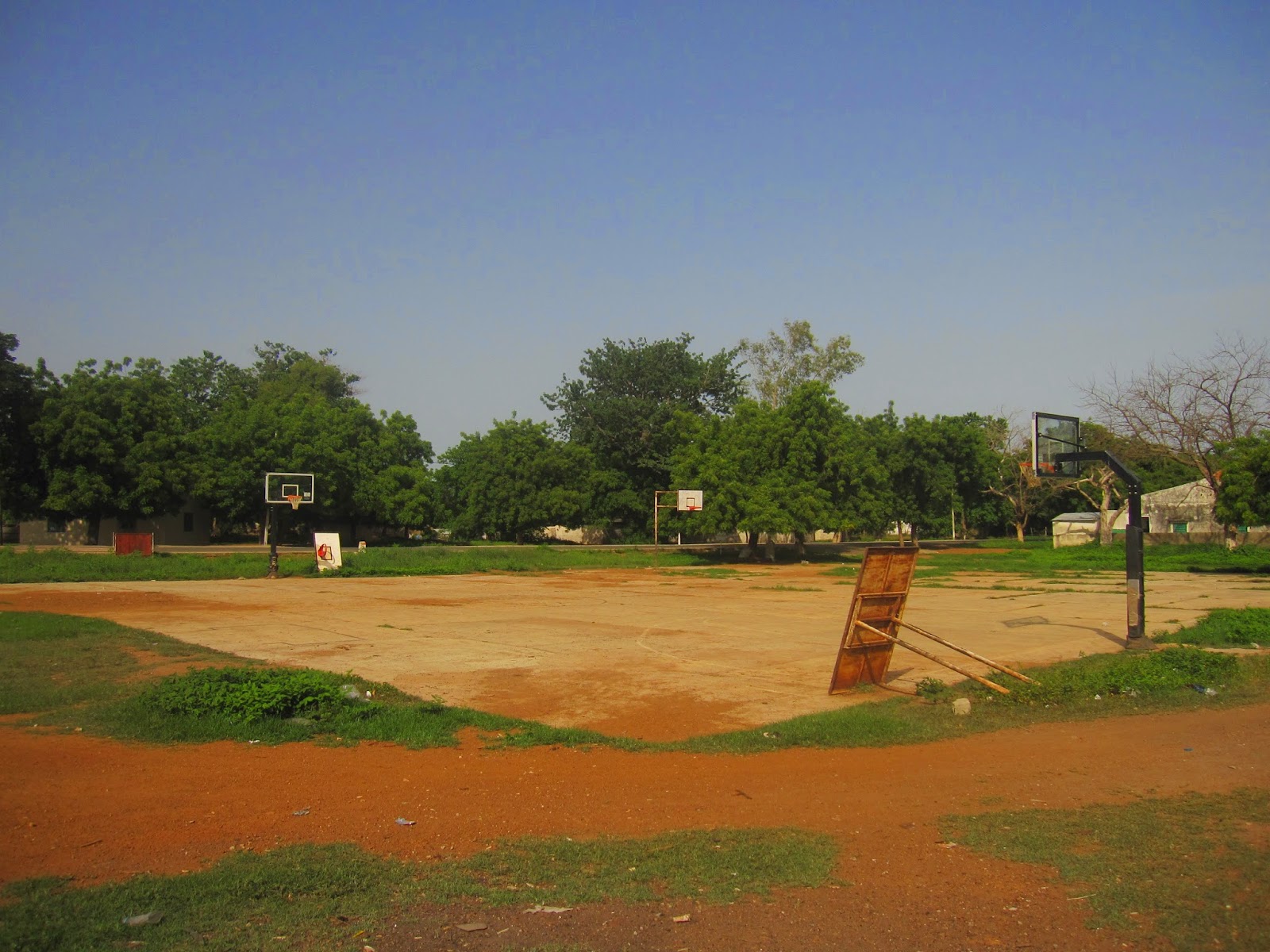
The Saraya basketball courts (courtesy of NBA Cares)


Downtown Saraya: the market, mosque & boutiques


Saraya mosque


The tailor shop outside my house with some of the boys who work there


My hut


My sister's daughter and my namesake's daughters; the spunkiest girls in all of Senegal.
(From left: Samuro, Kunadi, Allamuta)


My namesake's youngest son, Sambely


Me and Allamuta #1
(Study the faces carefully)


Me and Allamuta #2
(Study the faces carefully.
For anyone that has known me since childhood they should see be able too see the silly-picture/serious-picture pattern and see why Allamuta and I were so quick to become friends)


My sister, Dioucounda, braiding my hair for Korite (end of Ramadan celebration)


The outcome of the hair-braiding.
(All I wanted was to not look like Coolio...)


My host mom, Sadio (in the green/yellow dress with the red necklace and white head scarf), and some friends from around town on Korite


Diabou Tounkara and Diabou Tounkara
(I'm the one on the left, just in case you were confused)


My sister, Dioucounda, and her youngest daughter, Oumou


My host dad, Ibrahim, sitting in his favorite spot in the shade structure


Caroline (my site mate), Tess and I on our way to language seminar in Misserah Dantila (~60km from Saraya)


Me, Mr. Sall (Saraya English teacher) and my site mate, Caroline, at a party with all the local teachers